
About Public Schools

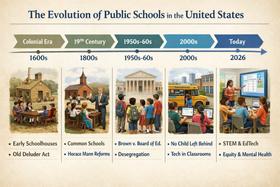
Here we cover the history of public schools, explain the various types and discuss their pros/cons. Learn more about technology on campus, health and nutrition issues, and the latest information related to a variety of student populations.

View the most popular articles in About Public Schools:

Bed Bugs in Schools? The Creepy Truth

Updated
|
Bed Bugs in Schools? The Creepy Truth
Think bed bugs only exist in motel rooms? Think again! Bed bugs may in fact be infesting public schools around the country.

Bed bugs are associated with dingy motel rooms, but more of these creepy crawlers are showing up in the most surprising places - including public schools!

School authorities in many areas are scrambling to dispel misconceptions and provide constructive information to help educators and parents keep the outbreaks under control. However, the news has many parents concerned about the safety of their children in school, as well as the possible infestations of the critter that could occur in their own homes.

What is a Bed Bug?

According to the Mayo Clinic, bed bugs are flat, oval creatures that are reddish brown in color. They are about the size of an apple seed, but are traditionally difficult to locate because they spend their days hiding in headboards, box springs and the cracks and crevices of mattresses. They come out to feed in the middle of the night, which is why people who have bed bugs in their homes typically wake up in the morning with evidence of bites on their face, neck, arms and hands. Bed bugs can be quite difficult to exterminate completely, particularly if the infestation has significantly grown before it was discovered.

Bed bug bites often appear as small red bumps with a smaller red dot in the middle. They are usually arranged in a line or cluster, and they can be quite itchy. In most cases, bed bug bites do not cause any major medical concerns, unless a person

. . .read more

Asbestos in Public Schools: Is Your Child at Risk?

Updated
|
Asbestos in Public Schools: Is Your Child at Risk?
Your child's public school could be the scene of asbestos. Learn about the risk factors and what schools have recently been impacted by the presence of asbestos.

Most parents send their children to school each day under the assumption that the campus is a safe environment for all of their students. If a risk is detected, parents generally believe that school officials will do whatever necessary to eliminate the risk before allowing children to return to the scene.

However, some public schools across the country have found dangers lurking within school walls, but have not quickly or efficiently addressed these toxins. This concern particularly applies to dangers lurking within walls quite literally, as well as floor and ceiling tiles. The danger in question here is asbestos exposure.

In this video, The Mesothelioma Center explains how many of America’s students, teachers and school staff are at danger of asbestos exposure because the deadly carcinogen lurks behind walls, above ceilings and under floors in older schools across the United States.

What is Asbestos?

According to the U.S. Environmental Protection Agency, or EPA, asbestos is a naturally occurring mineral fiber that was once commonly used in the construction of buildings. Asbestos was previously a desirable material because of its ability to insulate buildings efficiently and its relative resistance to fire.

Asbestos was widely used throughout much of the last century until health officials found a link between asbestos and some types of diseases in the 1970s. At that time, much asbestos was removed from buildings, although walls, ceilings, and floors were

. . .read more

Is Your Child's Public School Fertile Grounds for Cancer from PCBs?

Updated
|
Is Your Child's Public School Fertile Grounds for Cancer from PCBs?
The greatest danger on your child’s campus is not bullies, but rather cancer-causing PCBs. Learn about the presence of PCBs in schools and whether your child’s school is at risk.

When parents send their children to school, most worry about whether their children will like their teachers or succeed in their classes. Few are concerned about the potential of cancer-causing elements like PCBs lurking in or around their children's school grounds.

Alas, recent assessments of New York schools have raised some troubling findings that indeed have parents concerned about their children's exposure to these potentially harmful elements during school hours.

Study Uncovers Disturbing Findings

According to a report at the New York Times, a pilot study into the presence and potential risks of PCBs was conducted in New York City school buildings. In the first three schools examined, elevated levels of the compounds were discovered. Remediation work on the schools and surrounding areas has already begun, and the city's Department of Education has stated that all three schools are on schedule to open to students on September 8.

The Formation of the PCB Task Force

However, the assurance does little to calm the concerns of parents who send their children to schools in the city. One parent of a student at French Hill Elementary School in Yorktown Heights, Dr. Daniel Lefkowitz, discovered hazardous levels of PCBs around a window and in the soil around the school in 2004. His findings resulted in a major cleanup of French Hill Elementary that amounted to a total bill of more than $300,000.

The discovery also launched the beginnings of a PCB Task Force that calls

. . .read more

6 Tips on Transitioning Back to School

Updated
|
6 Tips on Transitioning Back to School
As kids trade swimsuits for book bags, help your child transition easily and peacefully from summer to the school year with these helpful tips. This article has been updated to reflect 2026 data and recent developments.

Summer may be coming to a close, but the school year is just beginning to ramp up. If you are concerned about how to transition your children from the relaxed pace of summer to a structured academic routine, you are not alone. Families across the country continue to face this adjustment each year, especially as schools place increased focus on attendance, mental health, and readiness in 2026. Take advantage of these tips to help the entire family transition back to school more smoothly.

Good Nights = Better Days

Kids tend to adjust to the school routine much better if they move into it gradually. It is particularly important to get your children on a good bedtime schedule to ensure they begin their new school year fully rested.

Begin moving the bedtime clock up by 30 minutes or so, a number of days before school begins. Establish a family dinner time and a relaxing evening routine that promotes restful slumber. Consistent sleep routines are strongly linked to improved academic performance and emotional regulation, according to the American Academy of Pediatrics.

Assess Physical Health

The National Association of School Psychologists (NASP) recommends scheduling doctor and dentist appointments prior to the start of school to give your child a clean bill of health before the school year begins. Schools in 2026 are also placing increased emphasis on student mental health screenings and early intervention. If you have concerns about your child's physical, emotional, or psychological development, discuss them with

. . .read more

At a Desk, but Without a Home: Homeless Students in Public Schools

Updated
|
At a Desk, but Without a Home: Homeless Students in Public Schools
Beyond tests and homework, some public school students face greater challenges, including the uncertainty of where they will sleep each night. Learn about the increase in homeless students and what public schools are doing to meet the challenge.

Homeless children face a myriad of issues, not the least of which is the ability to get a quality education. Unfortunately, the incidence of homeless families has been on the rise since the economic downturn began. Across the country, schools are working hard to ensure homeless students get a level playing field, with the hopes these children can get the education they need to move out of a life of poverty.

The National Law Center on Homelessness & Poverty states: "Homeless children and youth often have problems enrolling and participating in school. As a result, Congress passed the McKinney-Vento Homeless Assistance Act in 1987. This law gives homeless children and youth the right to:

  • Remain in the same school even if they move;
  • Enroll in a new school without typically required records such as proof of

  • residency, immunizations, school records, or other papers;
  • Get transportation to school;
  • Get all the school services they need; and
  • Challenge decisions made by schools and districts.

This video looks at the issue of homeless high school students.

Identifying Homeless Children

According to the National Association of School Psychologists, "homeless children include those who lack a fixed, regular and adequate nighttime residence." This might include children who live in shared housing, motels, cars or shelters.

Sometimes homeless students are identified directly, making it easy for school staff to provide the necessary assistance. However,

. . .read more

Recent Articles

Test Article, Image and Content
Test Test Test Test Test Test Test Test Test Test Test Test Test Test Test Test Test Test Test Test Test Test Test Test Test Test Test Test Test Test Test Test Test Test Test Test Test Test Test Test Test Test Test Test Test Test Test Test Test Test Test Test Test Test Test Test Test Test Test Test Test Test Test Test Test Test Test Test Test Test Test Test Test Test Test Test Test Test Test Test Test Test Test Test Test Test Test Test Test Test Test Test Test Test Test Test Test Test Test Test Test Test Test Test Test Test Test Test Test Test Test Test Test Test Test Test Test Test Test Test Test Test Test Test Test Test Test Test Test Test Test Test Test Test Test Test Test Test Test Test Test Test Test Test Test Test Test Test Test Test Test Test Test Test Test Test Test Test Test Test Test Test Test Test Test Test Test Test Test Test Test Test Test Test Test Test Test Test Test Test Test Test Test Test
10 Major Challenges Facing Public Schools in 2026
Explore 10 major challenges facing public schools in 2026, from funding gaps to teacher shortages, with insights for parents and educators.
Overview of the Funding of Public Schools (2026 Guide)
Learn how public schools are funded in 2026, including federal, state, and local sources, and what it means for equity and student outcomes.

About Public Schools

OVERVIEW OF PUBLIC SCHOOLS
A comprehensive look at the U.S. public school system, including history, governing bodies, funding, and services. Compare private, public and charter schools. Learn more about Magnet school programs and get tips on choosing the right school for your child.
TYPES OF PUBLIC SCHOOLS
Explore the different types of public schools, from charter to language immersion, and learn about the unique pros and cons of each type. Is a co-ed or single sex classroom best for your child? Charter school or magnet? Read expert advice and get valuable tips on the various public education programs available and how to choose what works best for your family.
TECHNOLOGY ON CAMPUS
From eBooks to web cams, technology on campus continues to grow. Learn how the latest technology impacts your child’s education. Get tips on the best ways to integrate technology into education and stay abreast of the latest developments and challenges facing schools.
HEALTH AND NUTRITION AT SCHOOL
From vending machines to Jamie Oliver, bed bugs to tuberculosis, we provide an in-depth look at health and wellness in public schools. Help your kids stay healthy on campus and learn about current health epidemics, vaccination requirements, physical fitness programs and the latest food initiatives.
BACK TO SCHOOL
Learn more about preparing your child and wallet for a new school year. Inside you’ll find valuable advice to help your family prepare for the transition from swimsuits to school. While there is no tuition, public school education does not come without costs. Learn more about budgeting for a new school year and get great money saving tips.
STUDENT POPULATIONS
The latest trends, laws and resources for a variety of student populations. Every child has different needs, and this section offers helpful information for LGBT, special education, gifted, low-income, and minority students.