Vouchers

Explore both sides of the school voucher debate. Learn what your options are, how those choices are funded and the impact on your local school district. From the latest government initiatives to results from recent studies, explore vouchers and the options they provide.

View the most popular articles in Vouchers:

Overview of the Funding of Public Schools (2026 Guide)

Updated
|
Overview of the Funding of Public Schools (2026 Guide)
Learn how public schools are funded in 2026, including federal, state, and local sources, and what it means for equity and student outcomes.

Overview of the Funding of Public Schools (2026 Update)

Understanding the funding of public schools is essential for parents, educators, and policymakers alike. School funding shapes everything from class sizes and teacher salaries to extracurricular offerings and facility quality. While the basic structure of funding has remained consistent for decades, recent policy shifts, economic pressures, and post-pandemic recovery efforts have made 2026 an especially important moment to revisit how public education is financed in the United States.

This updated overview explains where school funding comes from, how it is distributed, and why disparities persist across districts.

The Three Primary Sources of Public School Funding

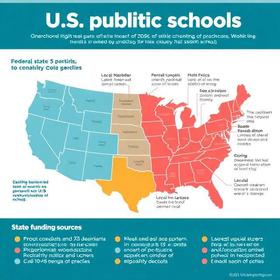
Public schools in the United States are funded through a combination of federal, state, and local sources. Each plays a distinct role, with varying levels of influence depending on the district.

1. Local Funding: Property Taxes and Community Wealth

Local funding remains the largest contributor in many districts, primarily through property taxes. Communities with higher property values generate more revenue, which often translates into better-funded schools.

Key characteristics of local funding:

  • Based on property tax assessments

  • Controlled by local school boards and municipalities

  • Highly variable between districts

This system creates significant disparities. Affluent areas can afford modern facilities, advanced coursework, and smaller class sizes, while lower-income districts may struggle to meet basic needs.

For a deeper look at how school quality varies by location, see Why Public School District Boundaries Matter.

2. State Funding: Equalization Efforts

State governments attempt to balance inequities through
. . .read more

School Vouchers 2026: Updated Pros and Cons

Updated
|
School Vouchers 2026: Updated Pros and Cons
Explore school vouchers in 2026, including updated pros, cons, policy changes, and what families should know before choosing.

School vouchers remain one of the most debated topics in American education policy. In 2026, the conversation has evolved significantly as more states expand school choice programs and families weigh new options beyond traditional public schools.

This updated guide to school vouchers 2026: updated pros and cons examines how voucher programs work today, what has changed in recent years, and what parents and educators should consider when evaluating their impact.

What Are School Vouchers?

School vouchers are publicly funded scholarships that allow families to use taxpayer dollars to pay for private school tuition, including religious schools in many cases. Instead of attending a zoned public school, eligible students can redirect funding toward participating private institutions.

Voucher programs vary widely by state. Some are targeted toward low-income families or students with disabilities, while others are becoming increasingly universal.

For a broader look at how public education systems operate, see this overview on how public schools are funded.

What’s New in School Vouchers for 2026?

The landscape of school vouchers has shifted rapidly over the past few years. Key updates include:

1. Expansion of Universal Voucher Programs

States such as Arizona, Florida, and Arkansas have expanded eligibility to nearly all students, regardless of income. These programs are often referred to as Education Savings Accounts (ESAs), offering even greater flexibility than traditional vouchers.

According to the National Conference of State Legislatures, more than a dozen states now offer some form of universal or near-universal school choice program.

2. Increased Legal and
. . .read more

Indiana School Voucher Program Changes the Scope of Public/Private School in the State

Updated
|
Indiana School Voucher Program Changes the Scope of Public/Private School in the State
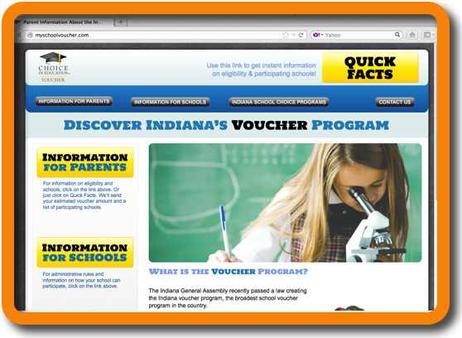
In Indiana, a voucher program is up and running and changing the face of public education in the state.

Voucher programs have become a hot topic of debate at school districts across the country, but Indiana is one of the first states to truly see firsthand how a voucher program can impact the scope of public and private school. This state is home to the most expansive voucher program in the nation, with more than 250 religious or private schools currently approved for the program. While more than 3,000 students statewide are expected to reap the benefits of the Indiana voucher program this year, not everyone is thrilled with the idea of taking tax dollars out of public schools to fund private education. With two sides to this hot-button issue, we’ll explore the full realm of state voucher programs, including how this particular program is changing the face of public and private education in Indiana.

Details of the Voucher Program

According to a recent report at U.S. Catholic, the Indiana voucher program passed the state legislature in the spring of this year, and since that time, around 250 private and religious schools have been approved by the state to participate in the program. This means that approved schools can admit students on scholarship, based on the family’s income levels. Scholarship money comes from the tax dollars that would normally be spent on public schooling. The equivalent of the per-pupil tax dollars goes directly to the family to be used to pay tuition and fees at the approved private school of the family’s choice,

. . .read more

Are Vouchers Destroying Public Schools?

Updated
|
Are Vouchers Destroying Public Schools?
Learn about the raging debate surrounding utilizing tax-funded vouchers to give students the freedom to choose their own public or private education -- and whether vouchers are indeed destroying the foundation of America's public schools.

School vouchers have been a controversial debate among community members and educators for more than a decade – and there are no signs of the debate simmering.

Vouchers are essentially a form of “tax scholarship” for public school students, wherein the educational tax (which typically is given directly to public schools) can be used to pay for alternative forms of education. With the voucher approach, taxes allow parents to send their children to a school of their choice; this money can even be used for private schools.

While many parents and educators believe that vouchers give students the freedom to seek out better educational opportunities, other individuals and experts assert that vouchers simply deprive struggling schools of receiving much-needed funding for improvement. With this great debate, one must question: are vouchers destroying or saving our public schools?

This video from NPR explains how vouchers work.

How Do Vouchers Work?

As public schools rely upon tax dollars for funding, each student who attends a public school is “worth” a certain amount of tax dollars. Each public school district or county is provided with a different “tax worth” for their students, which is determined in elections by community members.

For example, “District A” schools may receive $5,000 per student (annually), while “District B” may only be provided with $4,000 per student (annually). If “District A” is provided with more money and funding for each

. . .read more

Private School Vouchers: The Controversy

Updated
|
Private School Vouchers: The Controversy
Learn more about the debate behind private school vouchers and whether they are a viable public school alternative for your child.

Stirring up a raging political, social, and economic debate, the issue of school vouchers is a hot topic among community leaders, members, and educators. School vouchers, which essentially work as a scholarship, allow parents to redirect the trajectory of educational funding. Instead of applying tax dollars to schools directly, vouchers allow tax money to be sent to individual families. With this approach, parents and families can choose how their educational tax money is spent, allowing students to attend private or public schools, as the tax money can be used to pay for private tuition costs.

For proponents, vouchers offer students in failing schools access to greater educational opportunities in private schools. On the other side of the debate, many experts assert that vouchers, in the larger spectrum, will cause far more harm than good.

Vouchers and the Current State of Student Funding

While vouchers are still a relatively new concept and practice, the Supreme Court of Wisconsin approved of its state’s voucher program in 1998, which supported family-ownership of educational tax funds for approximately 15,000 children. With this private funding, children can choose from either public, private, or religious schools. This verdict was appealed to the United States Supreme Court after its passing, but the judges of the Supreme Court voted to not hear the appeal; therefore, Wisconsin has been able to continue its voucher approach to education for nearly a decade.

This video from The Young Turks discusses Louisiana's voucher program.

. . .read more

Recent Articles

Test Article, Image and Content
Test Test Test Test Test Test Test Test Test Test Test Test Test Test Test Test Test Test Test Test Test Test Test Test Test Test Test Test Test Test Test Test Test Test Test Test Test Test Test Test Test Test Test Test Test Test Test Test Test Test Test Test Test Test Test Test Test Test Test Test Test Test Test Test Test Test Test Test Test Test Test Test Test Test Test Test Test Test Test Test Test Test Test Test Test Test Test Test Test Test Test Test Test Test Test Test Test Test Test Test Test Test Test Test Test Test Test Test Test Test Test Test Test Test Test Test Test Test Test Test Test Test Test Test Test Test Test Test Test Test Test Test Test Test Test Test Test Test Test Test Test Test Test Test Test Test Test Test Test Test Test Test Test Test Test Test Test Test Test Test Test Test Test Test Test Test Test Test Test Test Test Test Test Test Test Test Test Test Test Test Test Test Test Test
10 Major Challenges Facing Public Schools in 2026
Explore 10 major challenges facing public schools in 2026, from funding gaps to teacher shortages, with insights for parents and educators.
Overview of the Funding of Public Schools (2026 Guide)
Learn how public schools are funded in 2026, including federal, state, and local sources, and what it means for equity and student outcomes.