Deprecated: Return type of Phpfastcache\Util\ArrayObject::offsetGet($offset) should either be compatible with ArrayAccess::offsetGet(mixed $offset): mixed, or the #[\ReturnTypeWillChange] attribute should be used to temporarily suppress the notice in /home/devzheng/workspace/psr/vendor/phpfastcache/phpfastcache/lib/Phpfastcache/Util/ArrayObject.php on line 106

Deprecated: Return type of Phpfastcache\Util\ArrayObject::offsetSet($offset, $value) should either be compatible with ArrayAccess::offsetSet(mixed $offset, mixed $value): void, or the #[\ReturnTypeWillChange] attribute should be used to temporarily suppress the notice in /home/devzheng/workspace/psr/vendor/phpfastcache/phpfastcache/lib/Phpfastcache/Util/ArrayObject.php on line 115

Deprecated: Return type of Phpfastcache\Util\ArrayObject::offsetUnset($offset) should either be compatible with ArrayAccess::offsetUnset(mixed $offset): void, or the #[\ReturnTypeWillChange] attribute should be used to temporarily suppress the notice in /home/devzheng/workspace/psr/vendor/phpfastcache/phpfastcache/lib/Phpfastcache/Util/ArrayObject.php on line 130

Deprecated: Return type of Phpfastcache\Util\ArrayObject::current() should either be compatible with Iterator::current(): mixed, or the #[\ReturnTypeWillChange] attribute should be used to temporarily suppress the notice in /home/devzheng/workspace/psr/vendor/phpfastcache/phpfastcache/lib/Phpfastcache/Util/ArrayObject.php on line 48

Deprecated: Return type of Phpfastcache\Util\ArrayObject::next() should either be compatible with Iterator::next(): void, or the #[\ReturnTypeWillChange] attribute should be used to temporarily suppress the notice in /home/devzheng/workspace/psr/vendor/phpfastcache/phpfastcache/lib/Phpfastcache/Util/ArrayObject.php on line 56

Deprecated: Return type of Phpfastcache\Util\ArrayObject::rewind() should either be compatible with Iterator::rewind(): void, or the #[\ReturnTypeWillChange] attribute should be used to temporarily suppress the notice in /home/devzheng/workspace/psr/vendor/phpfastcache/phpfastcache/lib/Phpfastcache/Util/ArrayObject.php on line 80

Deprecated: Return type of Phpfastcache\Drivers\Memcached\Item::jsonSerialize() should either be compatible with JsonSerializable::jsonSerialize(): mixed, or the #[\ReturnTypeWillChange] attribute should be used to temporarily suppress the notice in /home/devzheng/workspace/psr/vendor/phpfastcache/phpfastcache/lib/Phpfastcache/Core/Item/ItemExtendedTrait.php on line 438
Overview of Public Schools

Overview of Public Schools

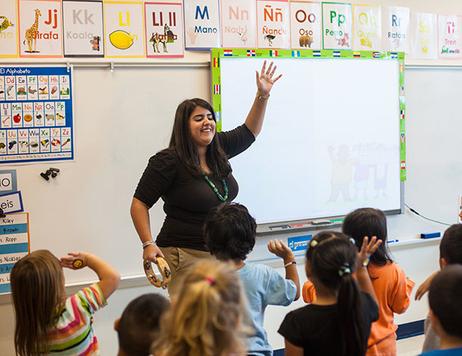
A comprehensive look at the U.S. public school system, including history, governing bodies, funding, and services. Compare private, public and charter schools. Learn more about Magnet school programs and get tips on choosing the right school for your child.

View the most popular articles in Overview of Public Schools:

Public Schools in a Minute

Updated
|
Public Schools in a Minute
Explore the diverse world of public schools in a minute! Our brief overview provides a snapshot of the educational landscape, school districts, curriculum, and more. Get a quick glance at the big picture of K-12 education.

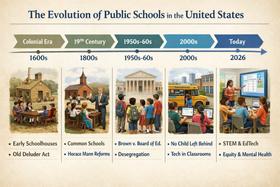
History of Public Education

The first schools in colonial America were private. Public schools per se came much later on in the 19th century. A History of Public Schools offers a comprehensive overview of the subject.

Funding and Budgeting

U.S. public schools are funded by local property taxes supplemented by funding from state and private sources. 92% of public school funding comes from non-federal sources. An Overview of the Funding of Public Schools explains how the system works. Here are two examples of school district budgets to illustrate the disparity regarding funding between a large urban school district and a small rural school district.

Large School District (Example):

Total Annual Budget: $1.2 billion

Sources of Funding:

  • State Funding: $700 million
  • Local Property Taxes: $300 million
  • Federal Grants: $150 million
  • Other Sources (e.g., donations, grants): $50 million

Expenditure Breakdown:

  • Instructional Costs (teachers, textbooks, supplies): $600 million
  • Administrative Costs (salaries, facilities, utilities): $200 million
  • Student Support Services (counseling, special education): $150 million
  • Transportation: $50 million
  • Building Maintenance: $50 million
  • Extracurricular Activities: $30 million
  • Debt Service: $20 million
  • Reserves and Contingencies: $50 million

Compare this hypothetical budget with the actual 2023-24 budget of the Houston ISD.

Small School District (Example):

Total Annual Budget: $10 million

Sources of Funding:

  • State Funding: $5 million
  • Local Property Taxes: $3 million
  • Federal Grants: $1 million
  • Other Sources (e.g., donations, grants): $1 million

Expenditure Breakdown:

  • Instructional Costs (teachers, textbooks, supplies): $4 million
  • Administrative Costs (salaries, facilities, utilities): $1 million
  • Student Support Services (counseling, special education): $500,000
  • Transportation: $150,000
  • Building Maintenance: $200,000
  • Extracurricular Activities: $50,000
  • Debt
. . .read more

Junior Reserve Officers Training Corps or JROTC

Updated
|
Junior Reserve Officers Training Corps or JROTC
JROTC offers valuable lessons in leadership, character-building and citizenship. Here's a look at the various JROTC programs out there together with a look at the pros and cons of the program.
Wikimedia.commons.org, public domain/PH3 Victoria A. Tullock, USN

Junior Reserve Officers Training Corps or JROTC

I was disappointed to read the story in the New York Times about abuse in an Army JROTC program. Why? Because I've always thought very highly of the program available in over 1700 public and private high schools. I will further disclaim that my eldest daughter was in the ROTC program at MIT while she was at Harvard. So, I know first-hand that it is well-run for the most part. The JROTC does an immense amount of good for young people at the high school level.

What is JROTC?

Congress established the JROTC or Junior Reserve Officers Training Corps in 1916. Each branch of the services has its own distinctive JROTC program. However, they all have the altruistic-sounding mission "To Motivate Young People to be Better Citizens."

The U.S. Army Junior Reserve Officers’ Training Corps (JROTC) is one of the largest character development and citizenship programs for youth in the world. Source: JROTC

  • Some people think that JROTC is a recruiting program for the military.
  • But it is not. Indeed, most JROTC participants do not join the military after graduating from high school.
  • Nor are they required to do so.
  • On the other hand, the college-level ROTC programs do require their participants to sign up for a tour of duty after graduating from college.
  • Simply put, the JROTC
. . .read more

The Benefit of Foreign Language Programs

Updated
|
The Benefit of Foreign Language Programs
Discover why foreign language programs remain essential in 2026. Learn how bilingual education strengthens cognitive development, academic achievement, cultural awareness, and college and career readiness, while helping parents evaluate the quality of world language instruction in public schools.

Ask education experts, employers, and university leaders about the value of learning a second language, and the consensus is remarkably consistent: schools with strong foreign language programs provide students with academic, cognitive, and career advantages that extend far beyond the classroom.

Public schools that invest in world language education, whether through dual-language immersion programs, elementary language instruction, or comprehensive middle and high school offerings, often see benefits reflected in student achievement, cultural awareness, and college readiness. The strongest programs begin introducing languages during the elementary years and continue through high school, giving students sustained opportunities to develop proficiency while exploring the cultures associated with the languages they study.

While access to foreign language education has improved in some districts, availability remains uneven across the United States. Many schools continue to face teacher shortages, scheduling limitations, and budget constraints that make it difficult to offer comprehensive language programs. At the same time, interest in dual-language immersion programs and multilingual education continues to grow as families recognize the long-term academic and professional value of bilingualism.

According to the National Center for Education Statistics (NCES), schools continue expanding opportunities that prepare students for an increasingly interconnected world, although access to advanced academic programs, including world languages, still varies considerably by district and state.

This video outlines the benefits of learning a foreign language.

There are many reasons why schools, even at the elementary level, should

. . .read more

Comparing Private, Public and Charter Schools

Updated
|
Comparing Private, Public and Charter Schools
We take a closer look at the pros and cons of three of the most popular education choices today – public, private and charter schools. Which is the best choice for your child?

Once children have graduated from diapers and baby food, the next big decision for parents becomes where to send their precious tots to school. There are many choices available to parents today, from the neighborhood school down the street to charter and private schools in the area. How does a parent know which school will be the best fit for his child? The choice is never easy, but it helps to weigh the pros and cons of each of these types of schools to see which might present the greatest benefit.

Cost

One of the first variables parents must weigh when comparing the various types of schools is cost. Public schools are “free” institutions by law, although they may charge fees and students may be required to provide their own supplies. Charter schools are also considered public schools, so there is no tuition cost assessed. However, private schools can – and do – charge tuition to students and their parents, and in some cases, those costs can be rather high.

According to a report at Fox News, the average tuition cost for private secondary schools during the 2007-2008 school year was around $10,500. Great Schools also cites statistics from the National Catholic Education Association that show while private parochial schools tend to charge lower tuition rates, the average tuition for these schools is still around $2,600 for elementary schools and nearly $7,000 for secondary schools.

Enrollment

Public schools are required to accept

. . .read more

An Overview of Public School Services

Updated
|
An Overview of Public School Services
Learn about some of the services available to students through the public school system that are especially helpful to low-income families.

Students in the public school system in the United States are eligible for a variety of services, depending on their needs. Under Title I, students in need are provided with additional assistance to promote their success in school and beyond. Title I funding is provided to more than 90 percent of the school systems across the country, with the money used in various ways to help low-income students break the cycle of poverty with the tools they need for academic success.

What is Title I?

Title I is one of the oldest public education programs in the United States and one of the largest. The program provides additional funding to school districts with a large population of low-income students to help students in this demographic meet the academic standards assigned by the state. The program was established as Title I of the Elementary and Secondary Education Act of 1965, and its purpose is to “ensure that all children have a fair, equal and significant opportunity to obtain a high-quality education,” according to the U.S. Department of Education website.

This brief video gives us an overview of Title I.

The Department of Education also lists strategies that local school districts should implement to achieve that purpose with the provided funding, which include:

  • Meeting the educational needs of low-income and minority students
  • Holding schools and governments accountable for the academic achievement of students
  • Use of tools, assessments, and
. . .read more

Recent Articles

Media Literacy as a Core Skill: How to Tell if a School Teaches It Well
Learn how to evaluate whether a public school teaches media literacy effectively, from fact-checking and source evaluation to digital citizenship and critical thinking.
Screen Time, Paper Learning, and the New Back-to-Basics Debate
Explore why some public schools are reducing screen time, bringing back paper learning, and rethinking the balance between technology and traditional instruction.
Student Data, AI Tools, and Privacy: Questions to Ask Your District
Learn how public schools use AI, protect student data, and the key privacy questions every parent should ask their school district in 2026.